
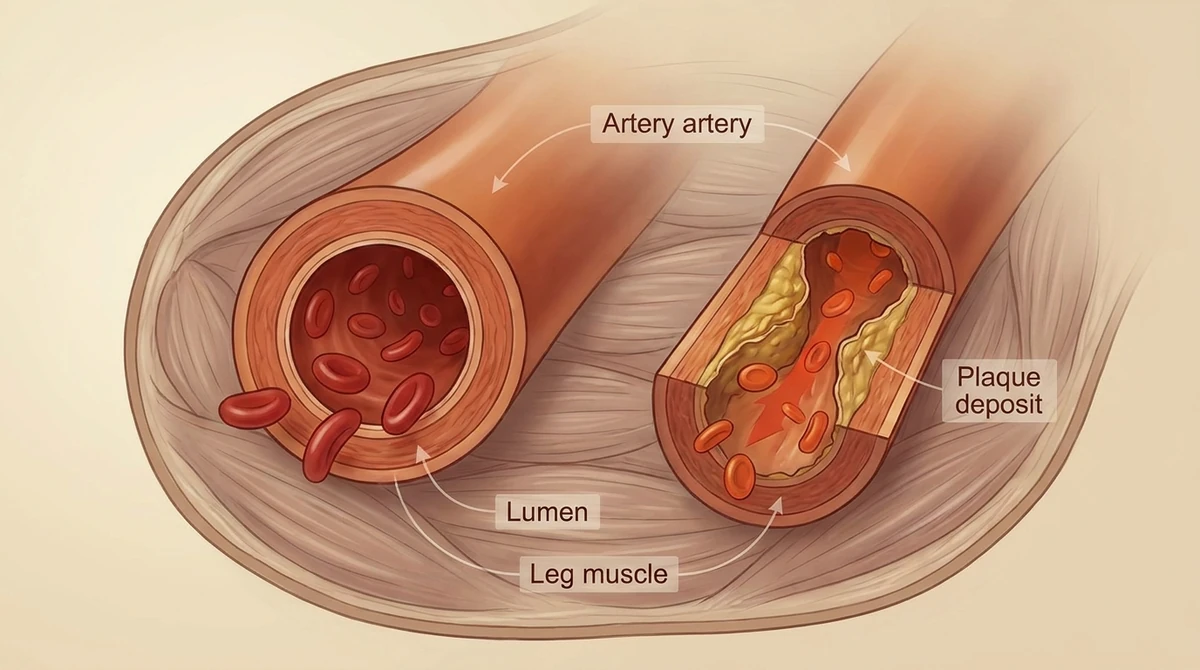
Have you noticed aching, cramping, or tiredness in your legs when you walk, only for the discomfort to improve once you stop and rest? It can be tempting to attribute these symptoms to getting older, being out of shape, or simply doing too much. However, this particular pattern of leg discomfort may be a symptom known as claudication.
Claudication is commonly associated with Peripheral Arterial Disease (PAD), a vascular condition in which narrowed arteries reduce blood flow to the legs. Recognizing this symptom can provide an opportunity to have your circulation evaluated and address PAD before it becomes more limiting.
Understanding what claudication feels like, why it happens, and when to see a vascular specialist can help you make more informed decisions about your vascular health.
What Is Claudication?
Claudication refers to muscle discomfort that develops when an area of the body does not receive enough blood flow to meet the increased demands of physical activity. It most commonly affects the legs.
When you walk or exercise, your leg muscles require additional oxygen and nutrients. Healthy arteries respond by supplying the increased blood flow those muscles need.
If an artery has become narrowed by plaque buildup, however, blood may not flow as freely. Your muscles may receive enough blood while you’re sitting or resting but have difficulty getting the additional supply they need during exercise.
The result can be cramping, aching, heaviness, or fatigue while walking. Once you stop and rest, your muscles require less oxygen. The discomfort may then improve within several minutes.
What Does Claudication Feel Like?
Claudication does not feel exactly the same for everyone. Some patients describe obvious cramping, while others experience subtler symptoms.
Possible symptoms include:
- Aching or cramping
- Muscle fatigue
- Heaviness in the legs
- Tightness
- Weakness
- Discomfort that develops while walking
Symptoms may occur in the calves, thighs, hips, or buttocks depending on which arteries are affected.
One of the most recognizable characteristics is the relationship between walking and rest. Claudication commonly develops after a certain amount of activity, improves when you stop, and returns when you begin walking again.
Why Is Claudication Associated With Peripheral Arterial Disease?
Peripheral Arterial Disease occurs when plaque accumulates along artery walls. This process, known as atherosclerosis, can gradually narrow the arteries and reduce circulation.
PAD frequently affects the lower extremities, making claudication one of its better-known symptoms.
The amount of discomfort doesn’t always correspond directly with the extent of PAD. Some people have significant arterial narrowing but relatively mild symptoms, while others notice leg discomfort earlier.
This is one reason symptoms alone cannot determine whether you have PAD. A vascular evaluation and diagnostic testing can provide a clearer picture of your circulation.
Why Do So Many People Ignore Claudication?
Claudication can be surprisingly easy to overlook.
Because symptoms primarily appear during physical activity and improve with rest, people may simply adjust their routines. Someone who once walked around the neighborhood might shorten the route. Another person may begin taking more breaks while shopping without thinking much about why.
The discomfort may also be attributed to:
- Normal aging
- Arthritis
- Muscle soreness
- Being out of shape
- An old injury
- Back problems
Over time, people may become less active to avoid triggering the discomfort. As a result, the underlying circulation problem can remain unnoticed.
If you repeatedly experience the same leg discomfort when walking, mentioning the pattern to your healthcare provider can help determine whether vascular testing is appropriate.
Claudication vs. Ordinary Muscle Soreness
Occasional soreness after physical activity is normal, particularly after trying a new exercise or increasing your activity level. Claudication tends to follow a more predictable pattern.
For example, you might consistently notice calf discomfort after walking several blocks. You stop for a few minutes, the discomfort improves, and you’re able to continue. After another similar distance, it returns.
Exercise-related muscle soreness, on the other hand, may persist after activity and can remain noticeable for hours or days.
Neither pattern should be self-diagnosed. However, recognizing how and when your symptoms occur can give your physician useful information.
Could Something Else Cause Leg Pain While Walking?
Yes. Leg pain has many potential causes, and not all discomfort while walking is related to PAD.
Other possibilities include:
- Osteoarthritis
- Muscle or tendon injuries
- Sciatica
- Spinal stenosis
- Neuropathy
- Chronic venous insufficiency
For example, spinal stenosis can produce leg discomfort during walking that resembles claudication. However, symptoms related to spinal stenosis may improve when sitting or leaning forward rather than simply stopping movement.
A medical evaluation can help distinguish vascular claudication from orthopedic, neurological, and other causes of leg pain.
Who Is More Likely to Develop PAD and Claudication?
Certain health and lifestyle factors are associated with an increased likelihood of PAD, including:
- Smoking or a history of smoking
- Diabetes
- High cholesterol
- High blood pressure
- Increasing age
- Family history of cardiovascular or vascular disease
Having these risk factors doesn’t mean you have PAD. However, recurring leg symptoms may be particularly worth discussing with a physician if you also have one or more PAD risk factors.
How Is Claudication Evaluated?
Evaluating possible claudication usually begins with a conversation about your symptoms and medical history. Your physician may ask where your legs hurt, what activities trigger the discomfort, and how quickly it improves after you rest.
Several non-invasive tests can also help evaluate circulation.
Ankle-Brachial Index (ABI)
An ankle-brachial index compares blood pressure at the ankle with blood pressure in the arm. Differences between the measurements can help identify reduced circulation in the legs.
Arterial Duplex Ultrasound
An arterial duplex ultrasound uses sound waves to evaluate blood flow through the arteries. It can help physicians identify areas where circulation may be reduced.
Additional vascular imaging may be recommended when more information is needed to understand the location or extent of arterial narrowing.
Can Claudication Be Treated?
Yes. Treatment depends on the extent of PAD, your symptoms, medical history, and how much the condition is affecting your daily life.
For some patients, management may begin with lifestyle changes, a structured walking program, and medications to address contributing cardiovascular risk factors.
When symptoms remain limiting or circulation is more significantly affected, minimally invasive treatments may be considered.
At Pedes Vascular Institute, arterial treatment options can include angioplasty, atherectomy, and stenting when appropriate. These image-guided procedures are designed to improve blood flow through narrowed arteries without traditional open vascular surgery.
Treatment is personalized because not every patient with claudication requires the same approach.
Don’t Let Leg Pain Quietly Limit Your Life
One of the most important reasons to recognize claudication is that people often begin changing their lifestyles around the symptom without realizing it.
Maybe you’ve stopped taking long walks because your calves become tired. Perhaps you avoid stairs, need more breaks while shopping, or no longer participate in activities you once enjoyed. Those changes are worth discussing with a healthcare provider.
Claudication doesn’t necessarily mean that you need a procedure, and leg pain doesn’t automatically mean you have PAD. It does, however, provide a reason to learn more about what may be affecting your circulation.
Get Your Circulation Evaluated at Pedes Vascular Institute
If recurring leg pain, cramping, heaviness, or fatigue is making walking less comfortable, a vascular evaluation can help provide answers.
At Pedes Vascular Institute in Irvine, CA, our physicians evaluate patients for Peripheral Arterial Disease and other vascular conditions using advanced diagnostic testing. When treatment is appropriate, we offer minimally invasive options designed to improve circulation, relieve symptoms, and help patients remain active.
You don’t have to assume that slowing down is simply part of getting older. If your legs consistently hurt when you walk and feel better when you rest, consider scheduling an evaluation with Pedes Vascular Institute to better understand your circulation and your options for care.